Hi guys! Monday time: new week and a new blog post to keep your brains busy :)
It seems like the world of technology, gaming and fashion decided to have it all these past few weeks, providing marketing practitioners with so many great case studies, tips and lessons. From London Fashion Week we can borrow some original social media marketing tools, while Grand Theft Auto V seems to be a true encyclopedia for the traditional b2c marketing. Finally, the new iPhone release demonstrated an updated marketing strategy.
Grand Theft Auto V - great marketing always pays off

GTA can be considered as a wonderful example of something being more than just a game/product, I guess. The gaming industry masterpiece, a real legend and a true brand - Scotland can be absolutely proud of its creation. And I can be proud to be a part of Scotland for this year :). Interestingly enough, this franchise represents the case of every ancestor being more successful than the predictor, which rarely happens for the movies. I compare the game launch with the movie premiers on purpose as it seems to be the strategy chosen by the Grand Theft Auto marketers. With all the digital resources and social media effectiveness, GTA team decided to follow the more traditional advertising and marketing path. Outdoor advertising, such as billboards (first to be spotted in Warsaw, Poland) and posters; video trailers and pictures leaks - helped created the demand months before the ‘supply’ was offered to the customers.
The approximate amount spent on the developing, production and marketing of the last GTA version accounts for £170 million, according to The Scotsman. This not so much tells us that expensive products require to be promoted accordingly, but illustrates the importance of the products’ quality which can be monetized afterwards. Over 300 people, including programmers, designers and mappers worked closely together to deliver outstanding results, making the launch of the updated game similar to the movie production. (By the way, it turned out my classmate`s husband has something to with the new GTA release, like he is a part of the development team or smth! It`s almost like I know a person who knows a real celebrity!) The preparation stage accounts for some great research made for the game to look as realistic as possible. Thus, the possible explanation for the choice of traditional marketing tactics can be the following: if a brand has to offer significant value, marketers should not be reinventing the wheel.

However, a couple of innovative things from the phenomenon of GTA could be noticed in the field of advertising. Thus, in one of the recent Forbes articles by Paul Tassi, the interesting question of in-game ads is explored. Product placement in movies as well as games can be considered quite a common technique. What is new, is the issue of whether every ads are helpful. Thus, Dodge (the most frequently featured vehicle in the game) does not hurry to take advantage of such free (?) promotion. Firstly, it is not clear if women represent the main target audience for Dodge (because 47% of GTA players are actually female). Secondly, the widely criticised violence as one of the game`s distinctive feature could be seen as rather harmful for the brands, apart the Grand Theft Auto per se. Overall, the record of £1 billion in sales within three days may only suggest that games are as good a place for product placement as the most successful Hollywood hits.
London Fashion Week - sometimes the only thing your customers need is a cup of tea.
 On the contrary to the GTA marketing strategy, LFW demonstrates the excessive usage of the social media channels, apps and tools for making retail. For instance, Topshop involved in their fashion week campaign two different apps: sound recognition technology ‘Chirp’ and ‘Customize the Catwalk’ application. The first one, despite the expectations did not work exceptionally well, as the software requires users to be present somewhere close to the actual location of event in order to receive information, in case of LFW - exclusive backstage pictures, videos and latest trends.
On the other hand, ‘Customize the Catwalk’ idea allowed Topshop fans to change the colours of the outfits at the very same moment they appeared on the runway. Overall, these social media and digital activities gained Topshop 8,130 Twitter mentions, says Marketing Magazine. This does not look bad at all for the mass market retailer when competing with high fashion brands.
Speaking of which, marketing chosen for the LFW by Burberry can be seen as a winner. With total number of 285,110 Twitter and Instagram mentions British trench coats icon proved collaboration strategy to be fruitful. Thus, Burberry and Apple worked together so that all the sharable content, such as pictures and video, was made before, during and after the catwalk with the use of iPhone 5S. The buzz around the new phone and the new cloths resulted into the doubled excitement of the trend hunters both in technology and fashion with a subsequent social media coverage.
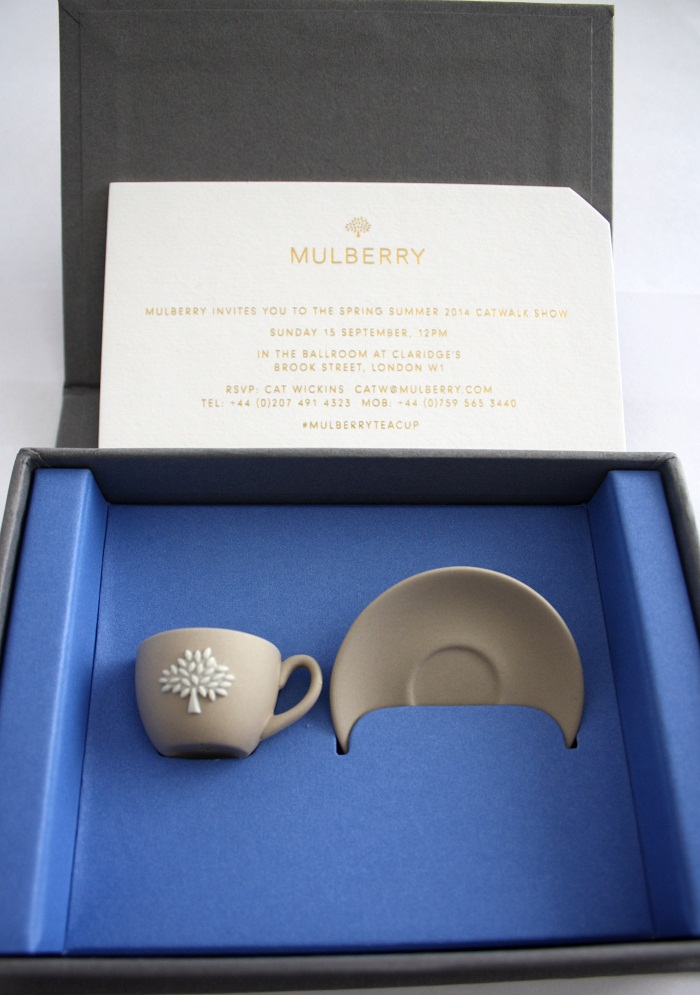 Finally, the third LFW label by the number of mentions is Mulberry. Interestingly, the brand almost reached Topshop (6,540 mentions vs 8,130) without any apps, softwares or collaborations. The pick of the social media resonance around Mulberry happened even before the start of the LFW. Invitations for the show is what made Mulberry the most talked about designer at those days. More than half of all the Tweets received were about the Wedgewood tea cups that the brand sent to the members of the guest list. These invitation were granted with a special hashtag #mulberryteacup, which received 147 mentions itself. To sum up, traditional ‘giveaway’ tactics may be as useful as innovative digital cases.
This seems like a hell of an article :) Sorry, I mean it is so long and comprehensive (I hope you agree), that I am extremely proud of it. Time to have a cup of tea and enjoy the rest of the day!
See you all soon,, here and in London!