Showing posts with label brands. Show all posts

Tuesday, 4 February 2014

What to expect in 2014 when it's already 2014?!?!

Aloha!!!!!!!!!

Can you believe that is really happening? Me neither, but that's for real - I am back for regular contribution to this blog, full of genious ideas and ready to impress you with every new post.
In this first paragraph let me quickly update you on what's happening in my life and on the 'where you have been hiding for the past little-bit-more-than-a-month' issue. I returned back home from Glasgow, celebrated Christmas and New Year, had great birthday party, celebrated Chinese New Year, got Glasgow-homesick (Glasgow-sick doesn't sound right...;) and have been actively looking for the perfect job! I have already had a number of interviews and almost been offered the President of the World role, but I will tell you more about it in my next post, while now I offer you to read the hopefully-still-relevant ideas on the Marketing/PR/Advertising trends of 2014!

I know it might be a little bit too late as 2014 has already arrived, but I tried my best to reflect this issue in the headline for this blog post to avoid confusion, disappointment and all those sad things. On the bright side, I had more than enough time to think this post through, read everything relevant news media had to offer on this topic and come up with some interesting ideas. Enjoy! And, please, come back for more, as I realised it will be too difficult to fit all 5 trends into one post. Hope, I have not lost your attention already...

The trends of 2014, according to me, are:


1. Storytelling is the thing of 2014

2. Transmedia storytelling/
cross-platform PR is hot

3. Old school is good as new

4. E-commerce is rising

5. UX is all about simplification 

1. Storytelling is the thing 


I don't think this will come as news to you that I advocate storytelling as the core to successful comunication. Not only have I finished online courses regarding this trend and already posted my ideas here, but started reading some cool literature on the topic as well! I am going to share it with you after I explain what is going to happen with storytelling in 2014. Wait for it. :-)

'No matter what you do, always and forever, our job is to tell our story, and that is never going to change. The way you make real money, the way you make real impact, the way things get changed is by great storytelling [...].  My biggest problem right now, in general, is that I feel that far majority of people, businesses, organisations, media organisations all across the board are storytelling like it's 2007 in 2014's world!' - says Gary Vaynerchuk in this inspiring video I have just found. In case you are to busy to watch it, here are some key notes I made from his talk:

  • 2014 is the year of micro stories and 'breaking news storytelling' as opposed to 'heavy and thick movie storytelling' (which still works in some cases). 
What has happened is that everyone suddenly got ADD (by the way I read that the guy who invented this disease admitted it was not a real thing, anyway). Therefore, supply and demand of attention is completely out of control. I do agree. Have you noticed that even dinners with friends in restaurants and cool coffee shops are now all about Instagramming the food, checking-in for Facebook and spending more time with your smartphone that your actual smartfriends? I wake up every morning and the first thing I do - check my phone, not that I am addicted, but yeah...that's my first source of news and I just can't not check them.
 
On the other hand, the one thing we totally do have control over, or at least think we do - is time. We like text messages, because we can respond to them anytime we want. We tweet, because we want to capture this exact moment. We watch all 3 seasons of Sherlock in one night and do not really care about BBC programming. 

Those two factor (our control over time and our lack of attention) are the biggest challenges for storytelling in 2014. What this means for storytellers and marketers is that, according to Gary, 'you have to tell your story where the eyes and ears of everybody are'. To illustrate, you spend money and kill trees to send catalogues to your 'potential' buyers and they end up in a trash bin without even being opened. Moreover, that huge expensive billboard will never be seen, as your target audience 'is not looking on your billboard, they are not even looking on the road, because they are too busy texting'. 

  • Quality storytelling always wins
The second cool thought I borrowed from Gary is that marketers ruin everything. They've ruined email marketing (which is now 'delete-spam-unsubscribe'), they are ruining Groupon, even Google Adwords is down by 15%. People don't watch YouTube ads, people hate annoying pop-up banners, journalists don't even look at our press-releases. To the contrary, P&G's 'Thank You, Mom' story is so touching, I can watch it forever. The same can be told about Dove's 'Real Beauty'. Those are not just commercials or instruments of selling stuff - they are stories of really high quality! If we think about marketing and PR in a broader sense, quality storytelling is recent Facebook 'Look back' tool (p.s. Happy Birthday, Facebook!!!). Moreover, I guess this is a highly valuable tool for brands who have their Facebook pages (I guess all of them do). Not sure if it is possible to create such video for business pages, but I guess it would be cool to see how their stories look like. Anyway, SMMs can ask themselves what those 'lookback' will look like for their products/pages/services. Will it all be about 'buy this/check this out/buy 2 get 1 free' or something meaningful/bright/hilarious/fascinating/shocking? 

I also think that product placement and branded entertainment are the most promising means of storytelling in 2014. With the first - you don't have to tell the actual story, but feature your product in the right story in a right way. While with the second, you get to tell a story with your product, about your product and in a way that is not as pushy as it is with commercials. Tough challenge which I guess is worth accepting! To provide you with at least one example of branded entertainment, IKEA and their 'Easy to Assemble' web series had really nailed the task.  
  • It's not about the CONTENT, it's about CONTEXT
Surprisingly, although IKEA, P&G and Dove excite us with brilliant content, Gary argues that in 2014 'where everyone gets fucked up' is that 'we think it is all about the content, and all the action right now is in the context'. Thus, social media channels are mainly considered by marketers as means of distributing information and this though is wrong. When this is your image of SNSs, you use them accordingly - write and share the same stuff on all the different social networks (it's like email distribtuions). The correct or the 2014's way to tell stories is to respect the psychology of different channels and their users. We should ask ourselves what people are doing on Twitter and what they'd like to see you, as a marketer, doing there. It may seem like a very 2007s advice, but never ever handle your Instagram/Facebook/Vine/Tumblr/ Twitter identically. I would also suggest to think twice whether your brand needs all of those contexts, because Instagram for a local dentist sounds too odd to me. ;-)  To sum up with Gary Vaynerchuk's quote: 'The context of the room changes the way you storytell'. 


Well, I guess that is too much of What's Trending talks for one blogpost! In my next 4 posts I will explain the rest of the tendencies, so don't give up on reading me just yet. 

See you soon!

P.S. This is the promised short reading list.

Avi Savar, Content to Commerce: Engaging Consumers Across Paid, Owned and Earned Channels
John Truby, The Anatomy of Story: 22 Steps to Becoming a Master Storyteller


Wednesday, 30 October 2013

PR Basics. Lesson 3: The Art of Telling the Story

Hi there,

The weather is so terrible these days and my feelings towards what is it I want to do in this life are so confused, that it was a real struggle today. (I know I promised to post something yesterday, but I hope you will forgive me). No, I still love you all and want to keep going, it is just one of those moments when you have to keep your dreams in mind and keep going.

There is so much to tell about PR basics, that I almost had no ideas what to share with you this time :-) We've already talked about strategy, target audiences, press release writing and media relations. Seems like it is time to write about...stories.

What is PR anyway? Hundreds of definitions may be given with all the references to Ivy Lee and Edward Bernays, but I was taught that real public relations is only possible to build when there is a great story present. In fact, just look at all those examples with Coca-Cola and recipe kept in secret, Susan Boyle and talent TV show, Apple and Steve Jobs, MasterCard and a guy who forgot his cash at home and than invented the first credit card ever and so on. All of these brands were made because of great PR and almost fairy-tale-like type of stories. But what if those stories have never happened, would we still know about and love those brands? Have those stories taken place at all or maybe they simply are the great examples of PR people outstanding skills of storytelling?

To start with, storytelling is something following me around these past few weeks. Firstly, I read about this big annual conference for PR specialists taking place in Ukraine where the main topic is going to be 'the importance of stories in PR' or something. Secondly, I have just started this new brilliant online course in storytelling organised by the University of Applied Science in Potsdam and could not be more interested in sharing what I have learnt so far with you.

1. Why is story important?

Like with all the great books, movies, TV series, myths and legends the magic (meaning the interest to the object of reading/watching/hearing) happens when the process of identification happens. Thus, if the audience realise they have some connections to the protagonists of the story or locations where everything happens, or sounds, smells, names - they start seeing a part of themselves in all of this. Similarly, with brands or other items for PR it is very important for potential customers to be linking themselves with the products/services which proves their loyalty. Brand can be appreciated for its prestigiousness/exclusiveness/britishness/mannishness or for being used by a certain people/group/class, and these distance features can only be established through a great story.

2. How do we create a story?

If you think that storytelling is important in PR only as a part of brand management, I can argue, there is so much more to it. Story is everywhere - in a press release you send to journalists, trying to make them interested; in campaign messages, in people you chose to be the speakers and even in the products you promote. And for every of these little tales there is one rule to keep in mind: the story should hook from the beginning (exposition), keep readers interested (confrontation) never let them go till the end (resolution). There are so many ways to hook your audience: some brand in their communication try to engage the audience with their long history and authority/trustworthiness/class (Guinness, Burberry, Rolls Royce), stories from Pepsi, MTV are supposed to hook young generation because these are the companies teens can identify their selves with.

On the other hand, it is possible to spot some patterns (cliches) in the PR stories borrowed from well-known legends/archetypes etc. For instance, Susan Boyle is a clear example of the Cinderella scenario, when somebody you pity at first becomes extremely successful kind-of-like-a-princes. The story with most of the politicians plays around Prometheus/Heracles characters -  very strong, confident personality with the ability to save the people of the given country and the whole world.

Now you probably think stuff like - hm...what about Samsung, Oreo, McDonalds and others - nah, we don't see any Cinderella-Prometheus happening with mobile phones, cookies, and fast food. Yeah, you are right, with products and services as opposed to people and fictional characters, stories may not follow a pattern in terms of plot, but archetypes do take place here as well. One can try to create something super-mega-hyper-wow with the overall PR&communication strategy, but in the end you will be able to see that your masterpiece is quite likely to be similar to something already know. Below I provide a diagram of the most popular cliches/patters/whatever used to create great stories.

There are a number of ways X and Y can be named. For instance, let X in the following example stand for 'Individualism vs Collectivism', while Y varies from 'Stability to Change'. So every brand can be described according to those attributes and place in the relevant corner of the diagram. I can now think of iPhone as very illustrative example of 'Individualism & Change' mix, as innovation, coolness and personality are among the brand values.

Change
(Dynamic, fast change, speed, risk, adrenalin, innovation)

Individualism Individualism CollectivismCollectivism
(Personality, uniqueness, exclusiveness)                          (Friendship, family/country/community values)

Stability
    (Power, authority, trust, strength)

Another brilliant classification of archetypes that help telling PR stories can be found in this guide by Synovate and their Synovate Censydiam methodology. The core of the system here is motivation, something that will make people buy/want to buy/identify themselves with a brand. I would recommend you look through the whole guide as it is full of great explanations and pictures, but the summery is below.

So the most common (archetypical) motives people have for doing things are represented by 8 colours. (I wonder if one can claim being super powerful because violet is their favourite colour :-)

Personal dimension is how we feel in relation to ourselves (we can either be very happy with ourselves and let our inner energy drive us - Enjoyment; or be very uncomfortable with what and who we are and behave like a control freak - no laughing, no staying up late, no driving fast - Control); while social dimension shows our relations to others (are we leaders who want to dominate - Power; or shy and discreet people who rather want to Belong to a group than lead it). And here are some examples from that guide on how this works in real life:

Enjoyment (adult toys archetype) = Smart cars that 'put mobility and entertainment at the heart of driving'

Conviviality = Beeline (Russian mobile operator) stand for 'connected people with a happy outlook on life in their communication'.

Belonging = Coca-Cola is the perfect example, as in the perception of the vast variety of people Coca-Cola equals holiday equals Christmas.

Vitality = Nike as 'testing your own limits and boundaries'

so on and so on. It is also really interesting that Beeline uses yellow, Coca-Cola is brown and Nike`s shoe boxes are red...

3. What do we do next?

Come back for more PR Basics tips next Tuesday and discover the answer.

Thanks again for making me come back to this blog and learn more and share it with you! =*

Your M.

Monday, 30 September 2013

Digital and B2C Marketing Lessons to Learn From the new GTA and LFW

Hi guys! Monday time: new week and a new blog post to keep your brains busy :)

It seems like the world of technology, gaming and fashion decided to have it all these past few weeks, providing marketing practitioners with so many great case studies, tips and lessons. From London Fashion Week we can borrow some original social media marketing tools, while Grand Theft Auto V seems to be a true encyclopedia for the traditional b2c marketing. Finally, the new iPhone release demonstrated an updated marketing strategy.

Grand Theft Auto V - great marketing always pays off 

GTA can be considered as a wonderful example of something being more than just a game/product, I guess. The gaming industry masterpiece, a real legend and a true brand - Scotland can be absolutely proud of its creation. And I can be proud to be a part of Scotland for this year :). Interestingly enough, this franchise represents the case of every ancestor being more successful than the predictor, which rarely happens for the movies. I compare the game launch with the movie premiers on purpose as it seems to be the strategy chosen by the Grand Theft Auto marketers. With all the digital resources and social media effectiveness, GTA team decided to follow the more traditional advertising and marketing path. Outdoor advertising, such as billboards (first to be spotted in Warsaw, Poland) and posters; video trailers and pictures leaks - helped created the demand months before the ‘supply’ was offered to the customers.

The approximate amount spent on the developing, production and marketing of the last GTA version accounts for £170 million, according to The Scotsman. This not so much tells us that expensive products require to be promoted accordingly, but illustrates the importance of the products’ quality which can be monetized afterwards. Over 300 people, including programmers, designers and mappers worked closely together to deliver outstanding results, making the launch of the updated game similar to the movie production. (By the way, it turned out my classmate`s husband has something to with the new GTA release, like he is a part of the development team or smth! It`s almost like I know a person who knows a real celebrity!) The preparation stage accounts for some great research made for the game to look as realistic as possible. Thus, the possible explanation for the choice of traditional marketing tactics can be the following: if a brand has to offer significant value, marketers should not be reinventing the wheel.

However, a couple of innovative things from the phenomenon of GTA could be noticed in the field of advertising. Thus, in one of the recent Forbes articles by Paul Tassi, the interesting question of in-game ads is explored. Product placement in movies as well as games can be considered quite a common technique. What is new, is the issue of whether every ads are helpful. Thus, Dodge (the most frequently featured vehicle in the game) does not hurry to take advantage of such free (?) promotion. Firstly, it is not clear if women represent the main target audience for Dodge (because 47% of GTA players are actually female). Secondly, the widely criticised violence as one of the game`s distinctive feature could be seen as rather harmful for the brands, apart the Grand Theft Auto per se. Overall, the record of £1 billion in sales within three days may only suggest that games are as good a place for product placement as the most successful Hollywood hits.

London Fashion Week - sometimes the only thing your customers need is a cup of tea.

On the contrary to the GTA marketing strategy, LFW demonstrates the excessive usage of the social media channels, apps and tools for making retail. For instance, Topshop involved in their fashion week campaign two different apps: sound recognition technology ‘Chirp’ and ‘Customize the Catwalk’ application. The first one, despite the expectations did not work exceptionally well, as the software requires users to be present somewhere close to the actual location of event in order to receive information, in case of LFW - exclusive backstage pictures, videos and latest trends.

On the other hand, ‘Customize the Catwalk’ idea allowed Topshop fans to change the colours of the outfits at the very same moment they appeared on the runway. Overall, these social media and digital activities gained Topshop 8,130 Twitter mentions, says Marketing Magazine. This does not look bad at all for the mass market retailer when competing with high fashion brands.

Speaking of which, marketing chosen for the LFW by Burberry can be seen as a winner. With total number of 285,110 Twitter and Instagram mentions British trench coats icon proved collaboration strategy to be fruitful. Thus, Burberry and Apple worked together so that all the sharable content, such as pictures and video, was made before, during and after the catwalk with the use of iPhone 5S. The buzz around the new phone and the new cloths resulted into the doubled excitement of the trend hunters both in technology and fashion with a subsequent social media coverage.

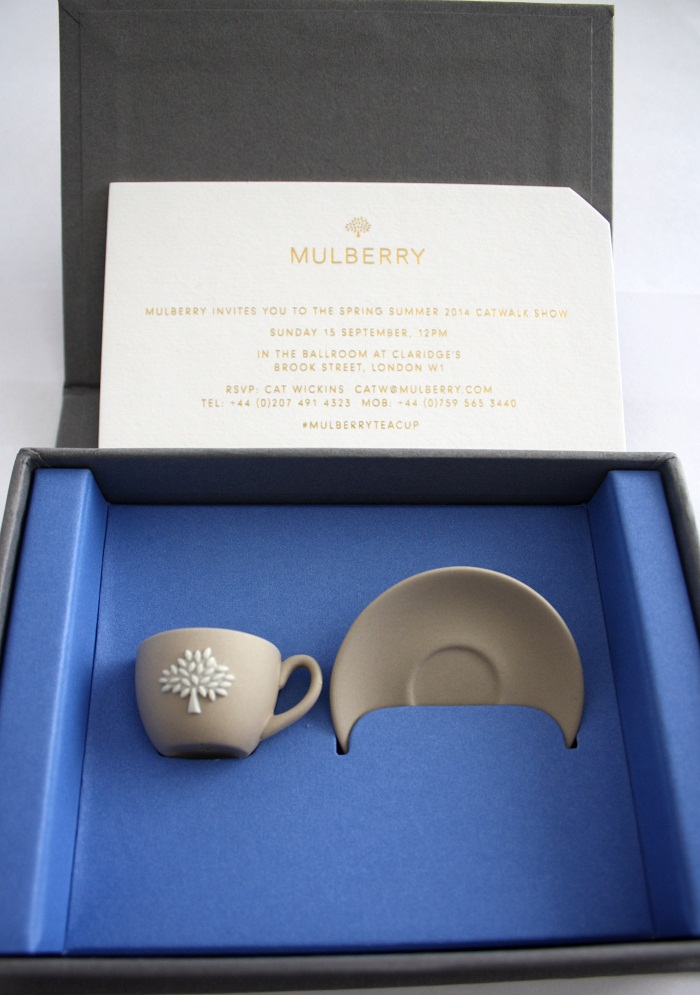
Finally, the third LFW label by the number of mentions is Mulberry. Interestingly, the brand almost reached Topshop (6,540 mentions vs 8,130) without any apps, softwares or collaborations. The pick of the social media resonance around Mulberry happened even before the start of the LFW. Invitations for the show is what made Mulberry the most talked about designer at those days. More than half of all the Tweets received were about the Wedgewood tea cups that the brand sent to the members of the guest list. These invitation were granted with a special hashtag #mulberryteacup, which received 147 mentions itself. To sum up, traditional ‘giveaway’ tactics may be as useful as innovative digital cases.

This seems like a hell of an article :) Sorry, I mean it is so long and comprehensive (I hope you agree), that I am extremely proud of it. Time to have a cup of tea and enjoy the rest of the day!

See you all soon,, here and in London!

Friday, 27 September 2013

Ukraine as a fast growing brand: see you in London

Hi everyone! Hope, you are doing great!

Today I decided to share with you something, which is probably not that much related to marketing, PR and digital, but is something which I know about a lot! No, it is not shopping or food and not even TV series, it is Ukraine! The country which I love and will be always coming back to!

There are two reasons I decided to write about my country just now:

1. I have started this new online course in brand management, and it made me think of the importanc country` brand plays in the overall brands hierarchy. We know French macarons, Belgian chocolate, Russain vodka! Of course other countries do produce chocolate and vodka and macarons, but they are less known for this stuff. So I thought, lovely Ukraine produces all of these food products and cars as well, by the way. We`ve got great IT people who created their own search engine and tablet, but you know....there is something missing for the Ukrainian brands strategy. I believe one should start from raising awareness. This is what I`m gonna do in the next couple of paragraphs.

2. The other reason would be this lucky coincidence. :) I am in the UK now, and suddenly, turns out that UK is soon hosting the first ever days of Ukraine in London! What a news! So I thought I will give this event a little promotion among my belowed readers.

Well, if you want to get to know more about Ukrainian art, music, cuisine, literature and fashion, but you are to scared to go to this mysterious place far-far-away, you should be packing your stuff and be looking forward to this great event in London!


In a nutshell, Days of Ukraine in the UK is organised by Firtash Foundation, which is this great organisation that helps  talented Ukrainian youths achieve their dreams and receive outstanding educational opportunities (as studying in Cambridge, for instance). The Foundation also takes active part in building Ukraine as a brand. Therefore, this event seeks to attract people from all over the world (because you can meet them all in London) to Ukrainian culture and traditions. So if you are going to spend those days in London, you will have a chance to familirise yourself with the best possible examples of Ukrainian stuff.

What: great mass event with free food, many positive emotions, great music, dancing and everything folk.

When: October, 17-19, which is Thursday, Friday, Saturday

Where: London. Different locations, so you better check out their website to see where you would like to go.

Who: 
Oleg Skrypka and Le Grand Orchestra. This guy used to be a real hipster back in 1989! When this word has not even been created yet. Check this hillarious video and you`ll see for yourself!


Now his music is a bit different, but the drive and the mood of his songs remains as fascinating as years ago! :) He created this two great festvals in Ukraine, makes amazing modern folk music and is also a judge of 'The Voice" show in Ukraine. If you ask me, which musician represents Ukrainian culture, I wouldn`t hesitate and answer Oleg Skrypka! This is one of his more recent videos:


BEVZA - prominent Ukrainian designer! Coco Chanel invented the 'little black dress' concept, but did you know that 'little white dress' concept can be trasted back to Svitlana Bevza? I would say the girl works in the best traditions of the western fashion trends and would be loved by COS, AllSaints, Reiss and Hobbs fans. Very simple, elegant and clean cut. Just to give you an idea, here is the video of her collection on the Ukrainian Fashion Week S/S 2013. 


And many more artists, musicians and fashion designers! You should totally come to London. :)

I am really happy this event is taking place, and I do agree that people performing at this festival are brilliant. It is just that I find myself representing Ukraine little bit differently. First, I start with showing some marvelous pictures and say 'Ukraine has it all - mountains, cliffs, 2 seas, snow and sand, forests and rivers'. I don`t have all the astonishing photos with me at the moment, therefore, I would recomend you take a look on the work of photographer Oleg Zharij and his series 'Gorgeous Ukraine'. 
 
My friend has a house just on top of the cliff :) I remember we used to watch dolphins from there. This is Black Sea coast in the southern part of Ukraine, the place is called Cape Fiollent and is also a popular movie location...for quite unpopular movies, unfortunately. :)

Last December we saw the first snow in Glasgow that winter and people were so happy seeing tiny snowflakes and I said to myself...you wanna see snow - come to Ukraine. In April (when I went back home on my Eastern Break) it was still snowing! 


This is how those Carpathian mountains look like during the summer - all green and marvelous.


Secondly, I would tell about some modern Ukrainian music. (I chose to talk about English-singing projects here, because they would be easier to understand).

    1. Kazaky - hot guys dancing on high heels whom you can spot in Madonna`s 'Girls Gone Wild' video and on the D&G runway. The following video kind of gives you an idea of how Customs and Border Office works in Ukrainian airports. :)


   2. HARDKISS - newly formed band of extremely creative, stylish and talented people who do great music.


    3. Esthetic Education - they were doing songs like those by Daft Punk (in terms of melody) in 2007 or even earlier. Love those guys. :)


That`s enough music for today. I am so looking forward to see (meet) all of you guys in London, October 17-19 where we will get the chance to have some real Ukrainian fun. In the meantime I wish you relaxing weekend full of joy and nice moments. I do hope you like this post, as for me, it seems like a nice idea to post something less serious at the end of the week. Let me know if you want to read more about Borshch and Varenyki (delicious stuff), Ukrainian cities or anything else!

Enjoy! :)

Wednesday, 25 September 2013

New iPhone and new marketing lessons

Hi guys! Thanks for reading my recent post, I really appreciate that!

As promised, today's story will feature the new iPhone (iPhones) and the marketing side of the product launch in particular. First of all, I have seen them both already, touched and used the new fingerprint scanner. Moreover, my flatmate has already got a brand new iPhone 5S in granite colour. (Happy Birthday Song!) Yes, actually black&white Apple phones are in the past (unless we are talking about 5C), they are now silver, granite and champaign (at least from my colour perception standpoint).

Another thing I was happy to know is that Glasgow is one of those places where you can get a new Apple product at the date of actual release, which was September 20th (and pre-order from September 13th). By the way, according to some 'street statistics' (the number of people I saw queuing in from of the Apple Store) at least in Glasgow new iPhones where successful. My friend told me that the store opened at 8.00 and at 8.30 everything was already sold out! In case you would need some more authoritative figures - 9 million copies were sold on the opening weekend. More info here.

With all the negative stuff, like bugs, fingerprint scanner hack and so on, my verdict is the following - I would still want to get a new iPhone, because it is cool, even the 5C (for me C actually stands for cool), but like I would not spend my last penny on it (which I did with my iPhone 4s). It is like the excitment is over.... Wait, iPhone advocates, before hating me, let me just explain my point in more details. I would not talk about the technology and 64-smth processor, because I don't really care, but Apple`s marketing strategy - this is what caught my attention. And yes, new iPhone is successful, but there was this thin line Apple people have almost crossed.


1. The art of keeping secrets. Me, and I believe all the Apple fans, where quite dissapointed when long before the date of official release, it was possible to find everything (95% of information, to be precise) on the new phone model - colours, design, innovative features etc. Yes, I get that every other year data licks happened, that`s ok - this makes the excitement stronger and adds to the intrigue (is it true? did you know the new iPhone will be crystal? similar rumors). The thing is that we never knew the whole truth before Jobs or Cook revealed the big mystery. Therefore, what I don`t get is why was it so hard to have the secret kept this year. You might disagree, but the stock market defends my opinion - the very same day after iPhones 5S and 5C were released, company`s stock went down by 5%! And experts say due to the lack of new information: we did not heard anything new - everything has been seen in advance.


2. The power of brand. In the new university course I have just started doing online, brand was defined as a relatonship between the manufacturer (creator) and the customer. It kind of like a promise, supported with additional value company gives to their customers. People are irrational about their consumer behaviour, therefore, what they want from brand is not so much the substance, but emotion. It is all about iPhone making you feel happy/excited/on top of the world/chosen/rich/whatever. I believe iPhone equals luxury. At least few years ago, back at home one could rarely find young people using the expensive Apple masterpiece.

They used to buy it to make a statement - every celebrity, fashion, art people prefer (prefered?) iPhones, because they were so deifferent and so much better than other smartphones. Nowadays, HTC and Samsung are not far behind (I`d say it`s rather arguable which smartphone has it all and which does not). Subsequently, Apple must stick with the basics - be luxurious. However, they decided to conquer the new markets and make the cheap, sorry, colourful version. Here I would like to quote this witty review on Wired by +Katie Collins:
'When Apple finally confirmed that it would be releasing a cheaper plastic iPhone, almost no one was surprised -- rumours and leaks have been rife for many months. What was more of a surprise was that the cheap, plastic iPhone wasn't quite so cheap and plasticky after all.'

To illustrate the point, according to the report by We Are Social, 81% of social media buzz around the iPhone 5C launch was negative, with almost a half of mentionings being critical about device`s design and more than a third dissappointed with the price.

On the one hand, the cheaper model was inevitable, because of the modern market enironment. Moreover, the same strategy seemed to work pretty well with the iPod and iPad mini. On the other hand, iPhone 5C is not that cheap to compete with the competitors and 'damages' (?) the luxury brand attribute. 


3. As the result, we can see the changing face of Apple brand. As I mentioned above, I guess 'C' now stands for 'cool'. This idea is proven by the recent research (12th annual CoolBrands survey) on brand perception, where Apple tops the list of the coolest brands, and not so much the list of luxury ones. I don`t know where the new marketing strategy is good or bad, we will see in a couple of years. Anyway, that`s a great topic for discussion - how big brands should adapt to the changing environments and how adaptable can the marketing strategy be. 


Let me know what you think!

Best regards,

M