Showing posts with label marketing. Show all posts

Tuesday, 4 February 2014

What to expect in 2014 when it's already 2014?!?!

Aloha!!!!!!!!!

Can you believe that is really happening? Me neither, but that's for real - I am back for regular contribution to this blog, full of genious ideas and ready to impress you with every new post.
In this first paragraph let me quickly update you on what's happening in my life and on the 'where you have been hiding for the past little-bit-more-than-a-month' issue. I returned back home from Glasgow, celebrated Christmas and New Year, had great birthday party, celebrated Chinese New Year, got Glasgow-homesick (Glasgow-sick doesn't sound right...;) and have been actively looking for the perfect job! I have already had a number of interviews and almost been offered the President of the World role, but I will tell you more about it in my next post, while now I offer you to read the hopefully-still-relevant ideas on the Marketing/PR/Advertising trends of 2014!

I know it might be a little bit too late as 2014 has already arrived, but I tried my best to reflect this issue in the headline for this blog post to avoid confusion, disappointment and all those sad things. On the bright side, I had more than enough time to think this post through, read everything relevant news media had to offer on this topic and come up with some interesting ideas. Enjoy! And, please, come back for more, as I realised it will be too difficult to fit all 5 trends into one post. Hope, I have not lost your attention already...

The trends of 2014, according to me, are:


1. Storytelling is the thing of 2014

2. Transmedia storytelling/
cross-platform PR is hot

3. Old school is good as new

4. E-commerce is rising

5. UX is all about simplification 

1. Storytelling is the thing 


I don't think this will come as news to you that I advocate storytelling as the core to successful comunication. Not only have I finished online courses regarding this trend and already posted my ideas here, but started reading some cool literature on the topic as well! I am going to share it with you after I explain what is going to happen with storytelling in 2014. Wait for it. :-)

'No matter what you do, always and forever, our job is to tell our story, and that is never going to change. The way you make real money, the way you make real impact, the way things get changed is by great storytelling [...].  My biggest problem right now, in general, is that I feel that far majority of people, businesses, organisations, media organisations all across the board are storytelling like it's 2007 in 2014's world!' - says Gary Vaynerchuk in this inspiring video I have just found. In case you are to busy to watch it, here are some key notes I made from his talk:

  • 2014 is the year of micro stories and 'breaking news storytelling' as opposed to 'heavy and thick movie storytelling' (which still works in some cases). 
What has happened is that everyone suddenly got ADD (by the way I read that the guy who invented this disease admitted it was not a real thing, anyway). Therefore, supply and demand of attention is completely out of control. I do agree. Have you noticed that even dinners with friends in restaurants and cool coffee shops are now all about Instagramming the food, checking-in for Facebook and spending more time with your smartphone that your actual smartfriends? I wake up every morning and the first thing I do - check my phone, not that I am addicted, but yeah...that's my first source of news and I just can't not check them.
 
On the other hand, the one thing we totally do have control over, or at least think we do - is time. We like text messages, because we can respond to them anytime we want. We tweet, because we want to capture this exact moment. We watch all 3 seasons of Sherlock in one night and do not really care about BBC programming. 

Those two factor (our control over time and our lack of attention) are the biggest challenges for storytelling in 2014. What this means for storytellers and marketers is that, according to Gary, 'you have to tell your story where the eyes and ears of everybody are'. To illustrate, you spend money and kill trees to send catalogues to your 'potential' buyers and they end up in a trash bin without even being opened. Moreover, that huge expensive billboard will never be seen, as your target audience 'is not looking on your billboard, they are not even looking on the road, because they are too busy texting'. 

  • Quality storytelling always wins
The second cool thought I borrowed from Gary is that marketers ruin everything. They've ruined email marketing (which is now 'delete-spam-unsubscribe'), they are ruining Groupon, even Google Adwords is down by 15%. People don't watch YouTube ads, people hate annoying pop-up banners, journalists don't even look at our press-releases. To the contrary, P&G's 'Thank You, Mom' story is so touching, I can watch it forever. The same can be told about Dove's 'Real Beauty'. Those are not just commercials or instruments of selling stuff - they are stories of really high quality! If we think about marketing and PR in a broader sense, quality storytelling is recent Facebook 'Look back' tool (p.s. Happy Birthday, Facebook!!!). Moreover, I guess this is a highly valuable tool for brands who have their Facebook pages (I guess all of them do). Not sure if it is possible to create such video for business pages, but I guess it would be cool to see how their stories look like. Anyway, SMMs can ask themselves what those 'lookback' will look like for their products/pages/services. Will it all be about 'buy this/check this out/buy 2 get 1 free' or something meaningful/bright/hilarious/fascinating/shocking? 

I also think that product placement and branded entertainment are the most promising means of storytelling in 2014. With the first - you don't have to tell the actual story, but feature your product in the right story in a right way. While with the second, you get to tell a story with your product, about your product and in a way that is not as pushy as it is with commercials. Tough challenge which I guess is worth accepting! To provide you with at least one example of branded entertainment, IKEA and their 'Easy to Assemble' web series had really nailed the task.  
  • It's not about the CONTENT, it's about CONTEXT
Surprisingly, although IKEA, P&G and Dove excite us with brilliant content, Gary argues that in 2014 'where everyone gets fucked up' is that 'we think it is all about the content, and all the action right now is in the context'. Thus, social media channels are mainly considered by marketers as means of distributing information and this though is wrong. When this is your image of SNSs, you use them accordingly - write and share the same stuff on all the different social networks (it's like email distribtuions). The correct or the 2014's way to tell stories is to respect the psychology of different channels and their users. We should ask ourselves what people are doing on Twitter and what they'd like to see you, as a marketer, doing there. It may seem like a very 2007s advice, but never ever handle your Instagram/Facebook/Vine/Tumblr/ Twitter identically. I would also suggest to think twice whether your brand needs all of those contexts, because Instagram for a local dentist sounds too odd to me. ;-)  To sum up with Gary Vaynerchuk's quote: 'The context of the room changes the way you storytell'. 


Well, I guess that is too much of What's Trending talks for one blogpost! In my next 4 posts I will explain the rest of the tendencies, so don't give up on reading me just yet. 

See you soon!

P.S. This is the promised short reading list.

Avi Savar, Content to Commerce: Engaging Consumers Across Paid, Owned and Earned Channels
John Truby, The Anatomy of Story: 22 Steps to Becoming a Master Storyteller


Thursday, 31 October 2013

Who is afraid of digital marketing? OR the Scariest Post so far!

Happy Halloween to everyone! :)


Never understood how scary holiday can be happy, though!;) Time to read about digital marketing tricks and treats inspired by this popular celebration.  Many news websites now offer their readers interesting pumpkin pie or soup recipes as well as coffee shops showcasing brand new pumpkin-flavoured lattes (I`ve tried one of those 2 days ago - not bad at all). 

Here is my Halloween marketing recipe.


1. Play with words

Did you know that every October the word ‘Pumpkin’ gets 20 times more searches than normal? Yes, this is pretty impressive and should be taken into consideration. What does this mean for us? Well, in our digital world we can plan content strategies around relevant holidays, celebrations or seasons; take trends onboard and craft content accordingly, having fun with wording, paying attention to keywords and tags.

Headlines are also important because of their power to increase engagement and readability of content. Therefore, I believe all Halloween headlines should be ‘killer’, content must be ‘scary-good’ and all of this better be accompanied with ‘to-die-for’ Tweets and Likes on Face-boo-k. Play with the words, turn them into hashtags, get involved in conversations and make the most out of the pumpkin hysteria!

2. Take pictures and make videos


Recently emerged phenomena of Vine and constantly growing popularity of Instagram encourage digital marketing practitioners to include those two apps (mobile social photo/video platforms) in their agendas even more. Six or fifteen seconds long, witty and creative videos may be a very good tool to use in the run up to October 31st. One of the most recent examples of great Vine Halloween-themed campaigns (fully described in AdWeek) was developed by washing powder brand Tide and consist of seven short viral videos. Every video clip features famous brand’s product in a well-known horror movie and a corresponding tagline, such as ‘Strains better be scared’ from the upcoming remake ‘Carrie’.


By the way, pictures of Halloween costumes may be also ‘Instagramed’. Moreover, if that’s a product you are launching or promoting, try putting a funny little costume on your product and make it Vine viral. Just imagine new iPad Air in a cute Batman cape :)

3. Create contests!

The last and probably the easiest idea to implement this last day of October as a part of digital campaign is to organise a contest. People love Facebook contests and so do I - they are engaging, easy-to-do and can only be limited to one's imagination. Photo sharing contest (such as of the craziest outfit or a handmade Jack O’Lantern; ‘guess a scary movie’ type of contest; the best Halloween meme; scariest-looking cupcake or even online trick-or-treating) can all be performed in order to make your brand more popular and more likeable while adding some life to your Facebook page.

Friday, 18 October 2013

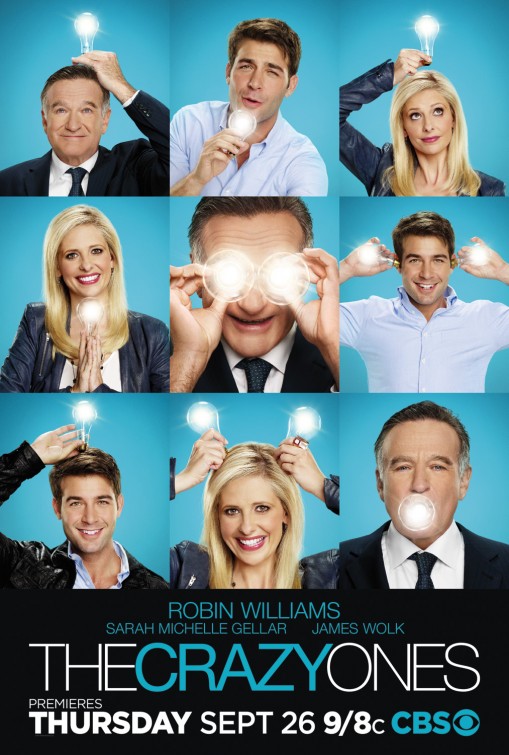
The Crazy Ones: 3 Lessons to learn from the new TV show

Friday post has arrived! Hi guys :)

So yeah, I promised to update this blog according to a schedule, but it turned out (I mean research showed) that Thursday is the best day for publishing serious stuff. Therefore, I guess will have a slight change.

It's gonna be:
  • Friday for Fun (I do hope you will find today's post cool and fun)
  • Tuesday for Teaching (PR Basics blog pst to learn something valuable)
  • Thursday for Therious Thtuff (does not seem to work this way, does it? I mean 'Serious Stuff). 

The Crazy Ones: 3 Lessons from the new TV show


Here we go, today I am going to share with you something that I have recently discovered - a witty TV show which can shed some light on how the industry of (creative) advertising works. It's like we already  know about media industry from the brilliant 'Newsroom', we also know about PR and ads from 'Mad Man', lets make something slightly different!

Is there anything else left to say? Apparently so! In just 3 (or 4, I have only watched 3 of them) episodes 'The Crazy Ones' - new comedy show on CBS starring Robin Williams and Sarah Michelle Gellar - not only made me laugh, but also provided with the inspiration for this blog post.

In a nutshell, and for those, who are going to watch this show soon (so I will not to give any spoilers here) - the show is about this creative agency that helps a whole range of clients to make their ads stand out. The agency is family run by very charismatic father  with quite an unusual managing style, and a daughter always trying to keep his crazy ideas closer to Earth. There are also other people in the creative team, such as hilarious Lauren (Amanda Setton's character -  u would probably know her from 'Gossip Girl'); charming Zach (James Wolk who appears in 'Mad Men') and a poor-thing Andrew (Hamish Linklater whom you have probably seen in 'Newsroom').

I believe there are three lessons one can learn from the first three episodes of the show.

1. Charisma is THE thing

Maybe I am not the one to judge (not yet), as this like my second year of working in a real PR industry; however, I have already observed that the most successful people in media/marketing/PR/advertising are those with an outstanding charisma. I mean of course you have to be capable of critical analysis, perform some strategical thinking actions from time to time and be able to see a bigger picture, but isn't the bigger part of those professionals everyday routine a simple communication? Meeting people, talking to them, trying to sell the story, persuading that this is THE idea client needs to implement and so on. You can be great in writing news, you can be brilliant in SWOT analysis, but if you lack that little (in fact huge) gift of charisma, oh man, you are stuck...

(By the way, do you know this joke:

- What do you do if you see a Spaceman?
- Park your car, man! )

It may only happen in movies and TV shows, but there is a chance that in reality your charisma may compensate a disasterous campaign, presentation or client meeting. As my boss likes to say: 'In the end, it is always about whether you would want to have a glass of wine with this person or not' (c).

2. Crisis is not always a challenge, but chance

If you don't know this yet, let me tell you that in Chinese the word 'crisis' or more specifically the two signs representing this word mean 'danger' and 'opportunity'; and this is a very smart way of looking at the crisis situations.

Thus, on the one hand if something goes wrong, the company/campaign/product may end up in a serious trouble. Whilst on the other, crisis can be played around in a way so the victim becomes a winner.

This situation is brilliantly illustrated in the Episode 2 of 'The Crazy Ones', where the coffee shop launch campaign and the massive outdoor installation created a real disaster not only for the creative agency, but the whole city. Luckily, the crazy ones have found a wonderful solution, making the disaster a great story for the new viral video (I guess I just told you the most of that episode, sorry:).

3. Importance of research

Yeah, you should always do your homework and be prepared. Even if you are not a sociologist (luckily I am, I mean...tend to), it is viral to remember that 6th sense, grandmother or whatever/whoever allows you making the right decisions quite often may let you down. On the contrary, a real solid research never will. Thus, in marketing/PR/advertising etc when the object of your work is aimed at people and more specifically their perception and reaction, testing, researching, evaluating and cross-checking is the key element.

This might seem funny and a bit silly, but marketers sometimes do rely on their own thoughts only - this is what is illustrated in the Episode 3 of 'The Crazy Ones'. Thus, Robin Williams' character came up with this idea for the commercial based on his past personal experience, but the reaction of the focus group participants' proved him wrong.

Moreover, I came across this situation while doing that online course in brand management, when students were asking questions like :"I don't agree that soap X is the most valuable brand this days, because I never buy it and it smells terrible. In fact, my friends never buy it either. Do you think your data may be incorrect?' Oh well, sociologists never lie (appart from when they tell us that one obese person plus one starved-to-death person makes it two 'normally-eating people'). To sum up, always test your ideas and strive to make them better and more effective.

Enjoy watching 'The Crazy Ones' and thank you all again for reading me! :)

Ever Mine,
Ever Thine,
Ever ours :)


Tuesday, 8 October 2013

PR Basics. Lesson 1: Strategy and Planning

Dear all! Long time, no see (I mean read), ha? Yeah, I know I have been quite short on blog posts these past two weeks - caught cold, went on a trip to Aberdeen (I will tell you about it soon), made some great professional achievements, almost finished that online course in brand management and conquered the world. :)

Now I am back, and first of all, would like to thank you sooooo much for reading me! Surprisingly, you people are coming back for more everyday and I appreciate that enormously. My special thanks to people from France (they seem to be the most active audience this week)- Merci beaucoup!

I decided to make some kind of a schedule, so that my blog will be updated quite regularly. Thus, if you want to read about some 'current issues in digital, marketing and PR' - please, check my blog on Mondays (at least). Today, and on the following Tuesdays I thought I will write pieces on the PR basics and than on Friday we will have fun discussing 'not-so-much-PRandMarketing' stuff.

Deal? Let me know what you think, and here comes the new blog post.

PR Basics. Lesson 1: Strategy and Planning

When people think of public relations many association have something to do with celebrities, buzz and glance magazines or spin doctors maybe. The one idea that unites all of these images is publicity which is a form or rather a part of public relations that may be characterised as fast results seeking tool: increase in the number of publication on the related topic, mentioning, Tweets and overall popularity. The missing component here is strategy or a deeper understanding of how PR functions. Not that you would not get any results; moreover, one might argue there is no such thing as bad publicity (or bad PR even), but without a clear understanding and therefore strategy you will end up in a place like:


Rachel: Yeah but y’know what they say Mon, "There’s no such thing as bad press."
Monica: You don’t think that umm, (reading) "The chef’s Mahi Mahi was awful awful," is bad press?

Quote from our favourite 'Friends' (The One With The Cooking Class)


Anyway, how can the general mission of every PR campaign be described? 

Let`s put it this way: there is a situation (product, service, person etc.) and people (audience) perceive it in a certain way, but we need to change this perception, so that the object will be seen as better/cheaper/fancier/smarter; and this is what PR does - changes perceptions or decreases the existing perception gap. 

Here is a sandwich, but you need people to consider it as an exclusive dish from Michelin star restaurant. How do we do that? One of my PR teachers used to give an example from O.Henry's 'Cabbages and Kings' where people leaving on that sandy island were trying to be convinced that they desperately need to get shoes. Perception gap would be 'why do you need shoes on a beach' and 'PR solution' appeared to be - place some itchy-sratchy stuff all over the island, so people won`t have a choice. Well, I guess that`s not really ethical example and the tactics chosen is far away from communicational; however, this story vividly illustrates the idea.


1. Start with research


It really is important to start with evaluating what you have and what are the expected outcomes. Interestingly, modern campaigners seem to neglect the importance of theory in their practice. The one possible explanation is that opportunistic product launches, promotions  and similar actions quite often deliver great results, so more people start to believe in the magic power of chance and destiny. Still, it should be argued that nothing happens without hard work and one can only allow sudden improvisations if they are properly planned in advance. This idea is being substantially challenged with all the digital world influence, because contrary to more traditional means of communication, the Internet and social media are rather difficult to control. So the Internet involved crisis are the most difficult to manage.

What is it every PR practitioner have to remember? The following guide might seem quite obvious for real PR sharks, so I designed it for beginners. However, with all the emerged digital opportunities even professionals tend to forget the basics. So, here is a 3 step mini guide to a great campaign strategy.

Every well planned project has to start with the phase where the object of PR is scrutinised in terms of what is good and bad about it. With the earlier mentioned example it would be like: is our sandwich delicious; is it easy to cook; do we need rare and expensive ingredients for it; can we make a vegan option etc. This should provide a clear idea of how this sandwich stands out from other snacks and what can be done to make it better. Later on, the similar analysis of the environment where the sandwich is going to be promoted has to be done: what type of food do people eat at this area; do they prefer fast food or a proper table; are there any other companies making sandwiches. The research should also involve the assessment of the perception gap - whose perception do we want to change; how those people see a sandwich; how do we want them to see it; how big is this difference. In the end of the research, having understood and articulated the gap, campaign objectives can be set.


2. Set clear objectives

This stage is as important as a previous one as it dictates the success of the results. If you do not know what you want to achieve, how will you achieve it? It is like when I go shopping without having a shopping list I end up buying all the unnecessary items (hm...actually I rarely cary a shopping list with me, so even if I know that I need a coat, a pair of shoes and a jumper quite often get to my shopping bag. So, yeah, stick to the plan!). Every marketing student knows the key to formulating excellent objectives - they just have to be:


S
M
A
R
T
p
e
c
e
i
e
a
h
l
m
c
s
i
e
e
i
u
e
v
d
f
r
v
a

i
a
a
n

c
b
b
t


l
l


e
e


SPECIFIC - Red Woollen Jumper
MEASURABLE - Size S
ACHIEVABLE - Go to H&M and stay away from AllSaints (they actually rarely sell red stuff, just so you know)
RELEVANT - Get a woollen coat and not a swimming suit, because it is +7 outside
TIMED - You need it today! (This is what clients would normally tell you even though it looks impossible)

( I just love those example with cloths and food. Feel free to send me food and T-shirts :)

In other words, clear objective have to be the ones easy to formulate, monitor and achieve. Another thing to remember about the campaign objectives is that they can be divided at least into the two categories: informational objective and motivational ones. Thus, when perception needs to be changed it can either be about wanting people to know and think something about your sandwich/jumper (awareness and attitude) or wanting them to buy and eat/wear it (behaviour). Depending on what is it you want to happen, the objectives will differ.


Levels of objectives:


Informational => Awareness
                         Attitude
(That`s like if you are asking you friend/boyfriend/mom etc to buy you a jumper, you should inform them what you want and why, and more importantly, convince them it is really vital for you to have that jumper) 

Motivational  => Behaviour

( That`s a tricky part - to get your friend/boyfriend/mom etc to go and get the jumper. I found some shops provide you with those cute greeting cards, where you just write your size, colour and the item you want. So that you can than present a card to the beloved ones and 'motivate' them to buy you a gift)


3. Finish with research

Start and finish with evaluation. This is the only way to know whether campaign goes successfully and if something can be done to improve it or to keep going. Therefore, the modern interpretation of SMART goals suggests they should be SMARTER, where E stands for evaluation and R for re-evaluation. Working on the mistakes and little victories is something that improves the quality of every process.

(Here I could have provided you with some great comparison and more jumper/sandwich examples, but I would really appreciate if you can share your ideas of what E and R stands for in a 'jumper/sandwich scenario')


Write to you soon! =*

Monday, 30 September 2013

Digital and B2C Marketing Lessons to Learn From the new GTA and LFW

Hi guys! Monday time: new week and a new blog post to keep your brains busy :)

It seems like the world of technology, gaming and fashion decided to have it all these past few weeks, providing marketing practitioners with so many great case studies, tips and lessons. From London Fashion Week we can borrow some original social media marketing tools, while Grand Theft Auto V seems to be a true encyclopedia for the traditional b2c marketing. Finally, the new iPhone release demonstrated an updated marketing strategy.

Grand Theft Auto V - great marketing always pays off 

GTA can be considered as a wonderful example of something being more than just a game/product, I guess. The gaming industry masterpiece, a real legend and a true brand - Scotland can be absolutely proud of its creation. And I can be proud to be a part of Scotland for this year :). Interestingly enough, this franchise represents the case of every ancestor being more successful than the predictor, which rarely happens for the movies. I compare the game launch with the movie premiers on purpose as it seems to be the strategy chosen by the Grand Theft Auto marketers. With all the digital resources and social media effectiveness, GTA team decided to follow the more traditional advertising and marketing path. Outdoor advertising, such as billboards (first to be spotted in Warsaw, Poland) and posters; video trailers and pictures leaks - helped created the demand months before the ‘supply’ was offered to the customers.

The approximate amount spent on the developing, production and marketing of the last GTA version accounts for £170 million, according to The Scotsman. This not so much tells us that expensive products require to be promoted accordingly, but illustrates the importance of the products’ quality which can be monetized afterwards. Over 300 people, including programmers, designers and mappers worked closely together to deliver outstanding results, making the launch of the updated game similar to the movie production. (By the way, it turned out my classmate`s husband has something to with the new GTA release, like he is a part of the development team or smth! It`s almost like I know a person who knows a real celebrity!) The preparation stage accounts for some great research made for the game to look as realistic as possible. Thus, the possible explanation for the choice of traditional marketing tactics can be the following: if a brand has to offer significant value, marketers should not be reinventing the wheel.

However, a couple of innovative things from the phenomenon of GTA could be noticed in the field of advertising. Thus, in one of the recent Forbes articles by Paul Tassi, the interesting question of in-game ads is explored. Product placement in movies as well as games can be considered quite a common technique. What is new, is the issue of whether every ads are helpful. Thus, Dodge (the most frequently featured vehicle in the game) does not hurry to take advantage of such free (?) promotion. Firstly, it is not clear if women represent the main target audience for Dodge (because 47% of GTA players are actually female). Secondly, the widely criticised violence as one of the game`s distinctive feature could be seen as rather harmful for the brands, apart the Grand Theft Auto per se. Overall, the record of £1 billion in sales within three days may only suggest that games are as good a place for product placement as the most successful Hollywood hits.

London Fashion Week - sometimes the only thing your customers need is a cup of tea.

On the contrary to the GTA marketing strategy, LFW demonstrates the excessive usage of the social media channels, apps and tools for making retail. For instance, Topshop involved in their fashion week campaign two different apps: sound recognition technology ‘Chirp’ and ‘Customize the Catwalk’ application. The first one, despite the expectations did not work exceptionally well, as the software requires users to be present somewhere close to the actual location of event in order to receive information, in case of LFW - exclusive backstage pictures, videos and latest trends.

On the other hand, ‘Customize the Catwalk’ idea allowed Topshop fans to change the colours of the outfits at the very same moment they appeared on the runway. Overall, these social media and digital activities gained Topshop 8,130 Twitter mentions, says Marketing Magazine. This does not look bad at all for the mass market retailer when competing with high fashion brands.

Speaking of which, marketing chosen for the LFW by Burberry can be seen as a winner. With total number of 285,110 Twitter and Instagram mentions British trench coats icon proved collaboration strategy to be fruitful. Thus, Burberry and Apple worked together so that all the sharable content, such as pictures and video, was made before, during and after the catwalk with the use of iPhone 5S. The buzz around the new phone and the new cloths resulted into the doubled excitement of the trend hunters both in technology and fashion with a subsequent social media coverage.

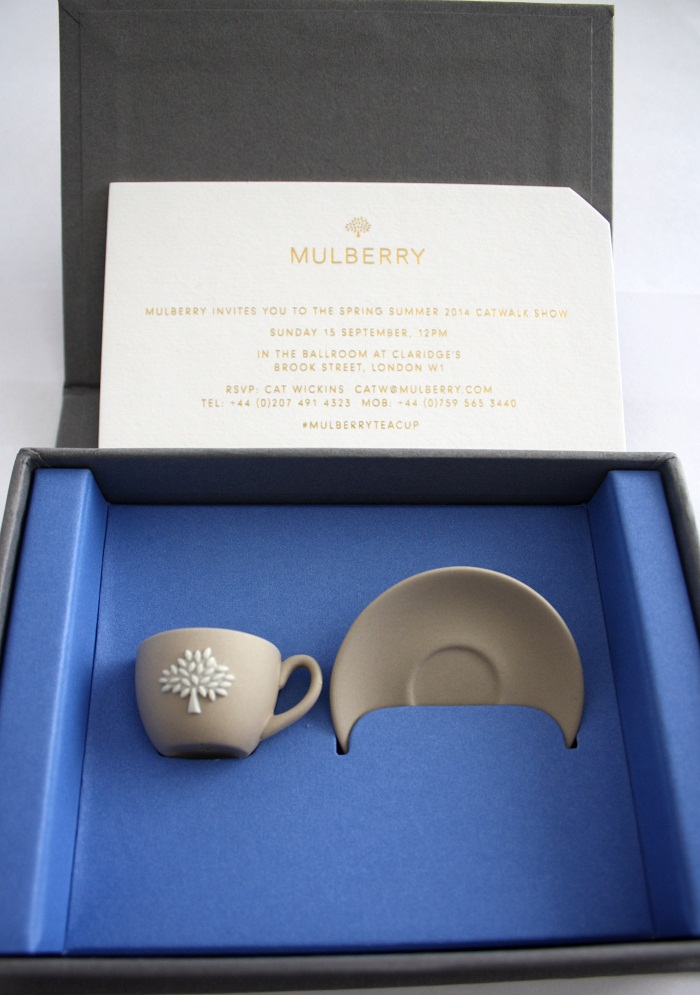
Finally, the third LFW label by the number of mentions is Mulberry. Interestingly, the brand almost reached Topshop (6,540 mentions vs 8,130) without any apps, softwares or collaborations. The pick of the social media resonance around Mulberry happened even before the start of the LFW. Invitations for the show is what made Mulberry the most talked about designer at those days. More than half of all the Tweets received were about the Wedgewood tea cups that the brand sent to the members of the guest list. These invitation were granted with a special hashtag #mulberryteacup, which received 147 mentions itself. To sum up, traditional ‘giveaway’ tactics may be as useful as innovative digital cases.

This seems like a hell of an article :) Sorry, I mean it is so long and comprehensive (I hope you agree), that I am extremely proud of it. Time to have a cup of tea and enjoy the rest of the day!

See you all soon,, here and in London!

Wednesday, 25 September 2013

New iPhone and new marketing lessons

Hi guys! Thanks for reading my recent post, I really appreciate that!

As promised, today's story will feature the new iPhone (iPhones) and the marketing side of the product launch in particular. First of all, I have seen them both already, touched and used the new fingerprint scanner. Moreover, my flatmate has already got a brand new iPhone 5S in granite colour. (Happy Birthday Song!) Yes, actually black&white Apple phones are in the past (unless we are talking about 5C), they are now silver, granite and champaign (at least from my colour perception standpoint).

Another thing I was happy to know is that Glasgow is one of those places where you can get a new Apple product at the date of actual release, which was September 20th (and pre-order from September 13th). By the way, according to some 'street statistics' (the number of people I saw queuing in from of the Apple Store) at least in Glasgow new iPhones where successful. My friend told me that the store opened at 8.00 and at 8.30 everything was already sold out! In case you would need some more authoritative figures - 9 million copies were sold on the opening weekend. More info here.

With all the negative stuff, like bugs, fingerprint scanner hack and so on, my verdict is the following - I would still want to get a new iPhone, because it is cool, even the 5C (for me C actually stands for cool), but like I would not spend my last penny on it (which I did with my iPhone 4s). It is like the excitment is over.... Wait, iPhone advocates, before hating me, let me just explain my point in more details. I would not talk about the technology and 64-smth processor, because I don't really care, but Apple`s marketing strategy - this is what caught my attention. And yes, new iPhone is successful, but there was this thin line Apple people have almost crossed.


1. The art of keeping secrets. Me, and I believe all the Apple fans, where quite dissapointed when long before the date of official release, it was possible to find everything (95% of information, to be precise) on the new phone model - colours, design, innovative features etc. Yes, I get that every other year data licks happened, that`s ok - this makes the excitement stronger and adds to the intrigue (is it true? did you know the new iPhone will be crystal? similar rumors). The thing is that we never knew the whole truth before Jobs or Cook revealed the big mystery. Therefore, what I don`t get is why was it so hard to have the secret kept this year. You might disagree, but the stock market defends my opinion - the very same day after iPhones 5S and 5C were released, company`s stock went down by 5%! And experts say due to the lack of new information: we did not heard anything new - everything has been seen in advance.


2. The power of brand. In the new university course I have just started doing online, brand was defined as a relatonship between the manufacturer (creator) and the customer. It kind of like a promise, supported with additional value company gives to their customers. People are irrational about their consumer behaviour, therefore, what they want from brand is not so much the substance, but emotion. It is all about iPhone making you feel happy/excited/on top of the world/chosen/rich/whatever. I believe iPhone equals luxury. At least few years ago, back at home one could rarely find young people using the expensive Apple masterpiece.

They used to buy it to make a statement - every celebrity, fashion, art people prefer (prefered?) iPhones, because they were so deifferent and so much better than other smartphones. Nowadays, HTC and Samsung are not far behind (I`d say it`s rather arguable which smartphone has it all and which does not). Subsequently, Apple must stick with the basics - be luxurious. However, they decided to conquer the new markets and make the cheap, sorry, colourful version. Here I would like to quote this witty review on Wired by +Katie Collins:
'When Apple finally confirmed that it would be releasing a cheaper plastic iPhone, almost no one was surprised -- rumours and leaks have been rife for many months. What was more of a surprise was that the cheap, plastic iPhone wasn't quite so cheap and plasticky after all.'

To illustrate the point, according to the report by We Are Social, 81% of social media buzz around the iPhone 5C launch was negative, with almost a half of mentionings being critical about device`s design and more than a third dissappointed with the price.

On the one hand, the cheaper model was inevitable, because of the modern market enironment. Moreover, the same strategy seemed to work pretty well with the iPod and iPad mini. On the other hand, iPhone 5C is not that cheap to compete with the competitors and 'damages' (?) the luxury brand attribute. 


3. As the result, we can see the changing face of Apple brand. As I mentioned above, I guess 'C' now stands for 'cool'. This idea is proven by the recent research (12th annual CoolBrands survey) on brand perception, where Apple tops the list of the coolest brands, and not so much the list of luxury ones. I don`t know where the new marketing strategy is good or bad, we will see in a couple of years. Anyway, that`s a great topic for discussion - how big brands should adapt to the changing environments and how adaptable can the marketing strategy be. 


Let me know what you think!

Best regards,

M